





What is atopic dermatitis? Where do we classify it? Is the disease hereditary?
Atopic dermatitis is an autoimmune disease that can occur at any age. It is characterized by dry skin and itching, and is most commonly present in children. Deficiency of certain fatty acids in the skin causes a significant amount of water to be lost in the upper skin, leading to dry skin and itching. This makes the skin more stressed and consequently very susceptible to various infections. Distinct scratching and rubbing further aggravates the condition as it makes the skin more susceptible to infections with bacteria, fungi and parasites. It makes sense to visit your personal doctor as soon as possible, as the diagnosis of atopic dermatitis is not easy to make. It is even more difficult or more complicated to find the cause of the disease. However, treatment of the disease usually lasts a lifetime, as the disease is chronic. Formal medicine does not yet know the cure for the disease.
Symptoms
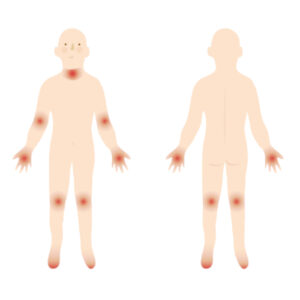
Symptoms most often appear in early childhood. In infants, rashes appear on the cheeks, neck and wrists, and in older children and adults, mainly on the elbows, knees and wrists, palms and fingers.

Diet and eating habits
In modern times, autoimmune diseases are on the rise. These diseases also include atopic dermatitis. Why? The reasons stem primarily from a genetically modified food (wheat, corn, etc.). Namely, in the old wheat / corn varieties from which most flour is made, it contained significantly lower amounts of gluten and similar molecules, but the yield of these varieties was relatively low. Nowadays, it is important for every grower to grow as much crop as possible on the smallest possible area. The old varieties did not provide this and it was necessary to develop and introduce new varieties (genetically modified, of course).
Gluten is certainly the first thing that makes sense to avoid as much as possible. Gluten from food can damage the intestinal wall… it definitely makes sense to increase the intake of good bacteria from the genus Lactobacillus and Bifidobacterium (full-fat yogurts and fermented dairy products (for example, kefin and / or regular EGO yogurt also contains these two).
If we want to test a paricular food, it is necessary to eliminate it from the diet for 3-4 weeks and monitor the symptoms or changes in the body. We then re-incorporate this food into the diet in larger quantities for 3-4 weeks and monitor the changes.
Harmful food include mainly fatty foods, dairy products, white flour, sweets.
Healthy food include essential fatty acids, vegetarian diet, probiotics, vitamin E. Essential fatty acids (e.g. linolenic acid) contain hemp, flaxseed, rapeseed and soybean oil. Large amounts of vitamin E are contained in spinach, broccoli, olives, almonds, hazelnuts, pistachios, avocados.
Diet summary:
- avoid milk and replace it with yoghurts and fermented dairy products,
- eliminate gluten flour and diet and replace it with old varieties (spelled, buckwheat),
- exclude citrus fruits and tomatoes,
- exclude fatty foods (pork) and replace it with white meat (poultry and fish),
- remove walnuts from your diet,
- include one “stamperle” of oil on an empty stomach (olive or hemp),
- Introduce the Asian diet into your food cycle, as it contains large amounts of vegetables and spices and is virtually fat-free.
- of nuts include almonds and Brazil nuts, peanuts and pistachios.
A healthy lifestyle can make a significant contribution to well-being. Drinking coffee and alcohol should be avoided. Large amounts of water need to be taken into the body. The food we take into the body should be as natural as possible, organically grown and one that contains high levels of vitamins and minerals. If you find an increased sensitivity to a particular diet, eliminate it and eliminate it from your diet.
Treatment with the help of classical medicine
Over-the-counter oral antihistamines (OTCs) can relieve itching. They work by blocking histamine, which triggers allergic reactions. Examples include:
- cetirizine (Zyrtec)
- diphenhydramine (Benadryl)
- fexofenadine (Allegra)
- loratadine (Claritin)
Many antihistamines can cause drowsiness, so it is recommended that you take them when you do not need to pay attention.
Cortisone (steroid) creams and ointments can relieve itching and flaking. However, after long-term use, they can have side effects that include:
- thinning of the skin,
- irritation,
- discoloration,
Low-potency steroids, such as hydrocortisone, are available over-the-counter. If your body does not respond to low-strength steroids, high-strength steroids may be prescribed by your doctor.
In severe cases, your doctor may prescribe oral corticosteroids. This can cause serious side effects, including bone loss. Your doctor may prescribe a topical or oral antibiotic to treat the infection.
Immunosuppressants are prescription drugs that prevent an overreaction of the immune system. This prevents outbreaks of eczema. Side effects include an increased risk of developing cancer, infections, high blood pressure and kidney disease.
Light therapy or phototherapy uses ultraviolet light to prevent immune system responses that trigger eczema. Multiple therapies are needed, which can sometimes help reduce or at least partially eliminate dermatitis. Phototherapy can also prevent bacterial skin infections.
Treatment with cannabis and cannabinoids
Currently, there are only a few studies on the topical use of cannabidiol (CBD) in people with skin diseases such as dermatitis. In recent years the amount of professional literature on this topic has been growing exponentially.
Cannabis and cannabinoids are increasingly used worldwide to treat a variety of dermatological conditions. In a 2020 article in The Journal of Dermatological Treatment, Sheriff and colleagues reviewed the literature on the pharmacology and use of cannabinoids in the treatment of a variety of skin conditions, including acne, atopic dermatitis, psoriasis, skin cancer, pruritus, and pain. Cannabinoids have shown anti-inflammatory, antipruritic, anti-aging and antimalignant properties through a variety of mechanisms, including interaction with the newly discovered skin endocannabinoid system, providing a promising alternative to traditional treatments.
In a 2019 study, Palmieri and colleagues applied a topical CBD-enriched ointment to participants with affected skin twice daily for 3 months.
After a 3-month period, participants noticed an improvement in the symptoms of skin inflammation.
Topical application of CBD ointment (without THC) has been found to be safe, effective, and can be used as a noninvasive alternative to improve inflammatory skin conditions such as eczema.
In a 2020 study, Maghfour and colleagues used CBD cream in participants with self-reported dermatitis and then reported their symptoms. Fifty percent of participants reported that their skin had improved by more than 60 percent.
How can we help ourselves with Hempethica products? In our team, with the help of experts in the field of dermatology, we monitor and develop topical preparations that can help us improve the condition of our skin. We develop products with the help of people who have patients with dermatitis.
Resources:
- https://www.healthline.com/health/eczema (accessed 2.11.2021)
- https://www.healthline.com/health/cbd-cream-for-eczema (accessed 2.11.2021)
– Palmieri B, Laurino C, Vadalà M. A therapeutic effect of cbd-enriched ointment in inflammatory skin diseases and cutaneous scars. Clin Ter. 2019 Mar-Apr;170(2):e93-e99. doi: 10.7417/CT.2019.2116. PMID: 30993303. Link
- Maghfour J, Rietcheck HR, Rundle CW, Runion TM, Jafri ZA, Dercon S, Lio P, Fernandez J, Fujita M, Dellavalle RP, Yardley H. An Observational Study of the Application of a Topical Cannabinoid Gel on Sensitive Dry Skin. J Drugs Dermatol. 2020 Dec 1;19(12):1204-1208. doi: 10.36849/JDD.2020.5464. PMID: 33346512. Link
- Sheriff T, Lin MJ, Dubin D, Khorasani H. The potential role of cannabinoids in dermatology. J Dermatolog Treat. 2020 Dec;31(8):839-845. doi: 10.1080/09546634.2019.1675854. Epub 2019 Oct 10. PMID: 31599175. Link
– Marks DH, Friedman A. The Therapeutic Potential of Cannabinoids in Dermatology. Skin Therapy Lett. 2018 Nov;23(6):1-5. PMID: 30517778. Link
Don't miss it

 Multiple sclerosis and cannabinoids
  Psoriasis and help with cannabinoids


Please can you let me know if the Seborrhoeic Dermatitis Cream is on sale yet. Or advise me on how to start therapy. Thank you and LP Darja from Voličina
Hello, Ms Darja
Thank you for your trust and interest in the cream. The cream or ointment will be available sometime in early September, as well as our other cosmetic products.
Greetings to you!
Team Hempethica